

ESG Management Strategy
We formulate and systematically implement actionable ESG strategies across environmental, social, and governance areas to ensure sustainable growth.

The Company has established ESG management as its core value and, to realize this vision, has defined qualitative goals incorporating strategic initiatives for each area, along with measurable quantitative targets (KPIs) to strengthen execution.
Going forward, MOTREX will embed ESG management across the entire organization based on this framework and, through annual performance reviews and system enhancements, will evolve into a leading ESG management company trusted by all stakeholders.
We formulate and systematically implement actionable ESG strategies across environmental, social, and governance areas to ensure sustainable growth.

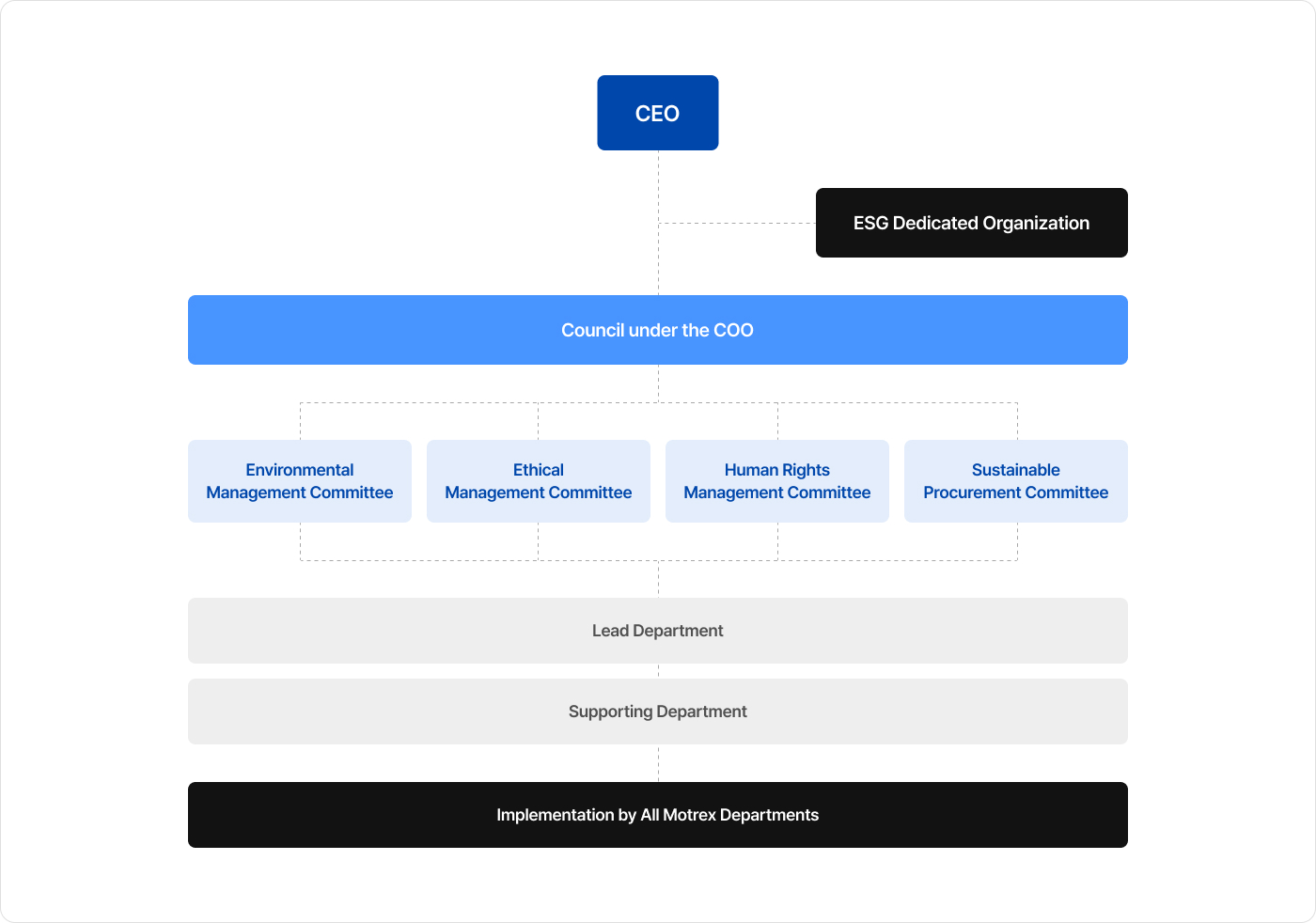
We have established a dedicated ESG organization based on company-wide collaboration and operate a responsible decision-making and continuous management framework.
We develop and implement a roadmap with phased goals and action plans to support long-term ESG management.
4 Core Values of
Environmental Management
Qualitative Goals
01
Strengthen core business competitiveness and expand new business and global customer portfolios
02
Advance the ESG management implementation system.
01
Manage environmental impacts by reducing greenhouse gas emissions, energy consumption, and waste generated in production processes
02
Establish and enhance the environmental management framework
01
Promote respect for human rights, labor, and diversity
02
Proactively manage health and safety risks and maintain a safe working environment
03
Support the growth of local communities and organizations
01
Reinforce ethical, compliant, and transparent corporate governance
02
Safeguard information security and key information assets
Manage ESG risks across the entire supply chain in collaboration with suppliers and establish responsible procurement standards
Quantitative Goals
Target Year: 2029*
- Achieve KRW 500 Billion + α in revenue
(a 59% increase compared to FY2024)
- Reach a 43% revenue share in Tier 1/2 segments
(a 30% increase compared to FY2024)
- Achieve an operating profit margin of 10.1% + α
(a 2.5% increase compared to FY2024)
- Hold ESG Council meetings at least once per quarter
(minimum four times per year)
- Achieve an ESG KPI integration rate of 70% or higher across key divisions
(focused on production, procurement, HR, and R&D)
- Enact and revise ESG policies and guidelines annually and maintain a 100% company-wide dissemination rate
- Establish a greenhouse gas inventory and achieve 100% collection and management of environmental data—including energy, emissions, and waste—across all business sites
- Carry out regular resource reduction campaigns on a quarterly basis
- Maintain discontinued and obsolete inventory costs below KRW 2.7 billion annually
- Establish and operate an Environmental Management Committee
- Maintain zero environmental regulatory violations and conduct quarterly monitoring of environmental regulations
- Maintain ISO 14001 Environmental Management System certification
- Achieve a 100% resolution rate for human rights and labor-related grievances
- Maintain zero serious human rights or labor violations, including discrimination and workplace harassment
- Maintain zero serious industrial accidents and achieve a 100% implementation rate of recurrence prevention measures for minor incidents
- Achieve a 100% completion rate for mandatory safety and health training for all
- Conduct regular safety inspections for high-risk processes and facilities with 100% coverage.
- Achieve a 90% or higher participation rate in job, leadership, and technical training programs
- Conduct community engagement and CSR initiatives at least twice a year
- Achieve a 100% completion rate for ethics, compliance, and anti-corruption training
- Maintain zero legal violations and a 100% compliance review rate for all new contracts and transactions
- Achieve a 100% collection rate of employee conflict-of-interest pledges
- Conduct information security audits at least once per year and achieve a 100% implementation rate of corrective actions
- Achieve a 100% completion rate for mandatory information security training
- Maintain zero major data breach incidents
- Conduct 100% annual risk assessments and on-site due diligence for targeted suppliers
- Collect Supplier Codes of Conduct and compliance pledges from 100% of targeted suppliers
- Conduct in-depth interviews with high-risk suppliers at least once per year
* Based on MOTREX’s separate financial statements and overseas subsidiaries
In 2025, MOTREX established a dedicated ESG organization to strengthen its role as a strategic control tower and formed an ESG Task Force Team (TFT) under this organization, composed of working-level representatives from each department, to build an ESG management framework.
The council under the COO establishes and manages qualitative and quantitative goals through sector-specific committees, and leads the identification and execution of on-site improvement initiatives, driving the company-wide internalization and advancement of ESG management.
MOTREX has established a mid- to long-term ESG roadmap to systematically embed ESG management and achieve phased growth. Going forward, the Company will continue to pursue its strategic objectives sequentially, from foundational infrastructure establishment to system advancement and sustainable management leadership.
2025–2026

- Establish a governance framework for the ESG organization and Council, and finalize the ESG vision, core values, and area-specific goals.
- Prepare an initial ESG KPI-linked performance management framework.
- Refine policies and standards related to human rights, safety, and working conditions.
- Formulate a basic framework for supply chain ESG risk assessment and evaluation.
- Secure environmental and safety data and develop future data management plans.
2027–2028
- Embed KPIs across departments and job functions and operate performance monitoring systems.
- Implement ESG-driven innovation initiatives across core business areas, including eco-friendly design, processes, and products.
- Implement programs to embed human rights, safety, and organizational culture.
- Assess, improve, and enhance supply chain ESG evaluation programs.
- Conduct environmental impact assessments based on Life Cycle Assessment (LCA) at both product and process levels.
2029–2030
- Regularize ESG disclosures and third-party verification processes.
- Institutionalize performance and compensation linkage systems based on ESG KPIs.
- Establish standardized internal capability development frameworks aligned with changes in job roles and technology.
- Gradually expand ESG support initiatives (e.g., incentive programs) for the supply chain.
- Increase the proportion of eco-friendly and low-carbon products and solutions in the portfolio.

By integrating advanced IT technologies into automobiles,
we provide drivers with safety and enjoyment.
ADDRESS : 56, Geumto-ro 80beon-gil, Sujeong-gu, Seongnam-si, Gyeonggi-do (Geumto-dong, Withen Tower, Building A)
CEO : Lee Hyung-HwanBusiness Registration No : 108-81-50292
TEL : +82-70-4892-6000FAX : +82-2-6280-1170Customer Service Hotline : +82-2-6959-1122
 MOTREX Linkedin
Designed by Website.co.krCOPYRIGHT @ 2026 MOTREX. ALL RIGHTS RESERVED.